
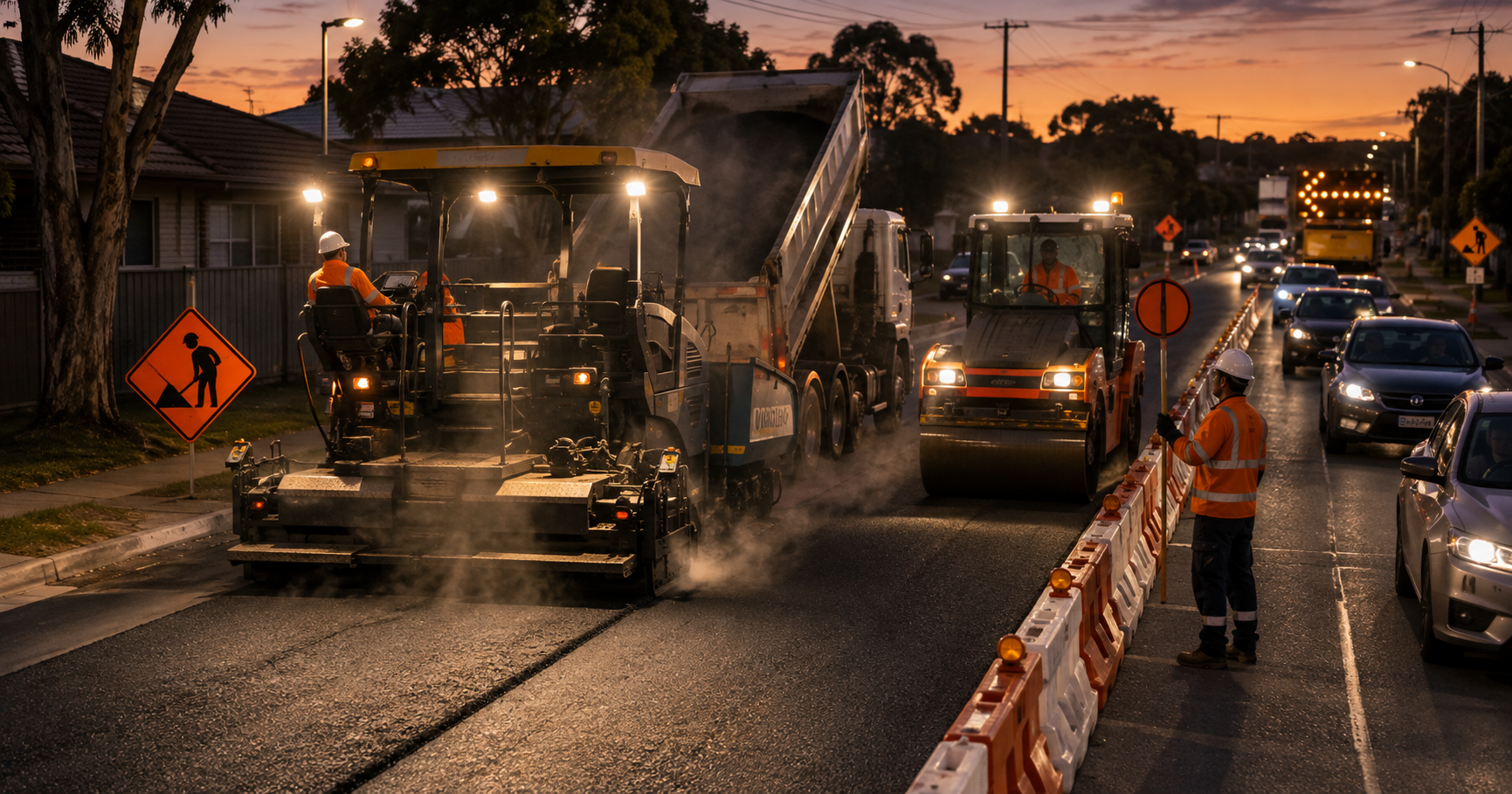
Road resurfacing and asphalt works are among the most common types of civil maintenance projects carried out on Adelaide’s road network every year. They improve road surfaces, extend pavement life, and deliver measurable safety benefits for road users — but they also create a period of elevated risk during the works themselves. Hot asphalt, heavy paving equipment, line marking vehicles, and roller trucks all operate in close proximity to live traffic, often at reduced speeds and in constrained lane configurations that require careful, active management.
When traffic management around asphalt and resurfacing works is done well, the project runs smoothly, workers are protected, and road users experience minimal disruption. When it is poorly planned or inadequately resourced, the risks — to workers, to passing motorists, and to the project programme — are significant.
This guide covers what professional traffic management for asphalt and road resurfacing works actually involves, why it is more complex than many contractors initially expect, and what principal contractors and project managers need to plan for before works commence.
Why Asphalt and Resurfacing Works Create Specific Traffic Management Challenges
Not all road works are created equal from a traffic management perspective. Asphalt and resurfacing projects have a set of characteristics that make their traffic management requirements distinctly more demanding than other types of construction activity.
The work zone moves
Unlike a fixed excavation or a static utility repair, a resurfacing operation progresses along the road as work is completed. The traffic management arrangements need to move with it — requiring a dynamic, responsive setup that can be repositioned safely and efficiently as the paving crew advances. Static traffic management that was correctly positioned at the start of a shift may be completely inadequate by the end of the day.
The Equipment is Large and Slow
Paving machines, rollers, and line marking equipment are heavy, slow-moving, and have significant blind spots. They occupy considerable road width and create frequent stop-start conditions for following traffic. Managing the interface between this equipment and live road traffic requires active, experienced supervision — not just signs and cones.
Hot Asphalt Creates Time Pressure
Asphalt must be laid and compacted within a specific temperature window before it cools and becomes unworkable. Traffic management delays that interrupt the paving operation have direct programme and cost consequences — which creates pressure to keep the operation moving that must be balanced against safety requirements.
Works often occur on High-Speed Roads
Road resurfacing is frequently required on arterial roads, highways, and expressways — environments where traffic is travelling faster and the consequences of a traffic management failure are more severe. High-speed environments require greater advance warning distances, more robust delineation, and more stringent controller positioning than urban street environments.
Night Works are Common
To minimise disruption to daytime traffic, many Adelaide resurfacing projects are scheduled for overnight or early morning hours. Night works introduce additional visibility challenges — for both workers and approaching drivers — that require enhanced lighting, brighter signage, and more attentive controller management than equivalent daytime operations.
What a Traffic Management Plan for Resurfacing Works Covers
Every asphalt and road resurfacing project on a public road in Adelaide requires an approved Traffic Management Plan before works can commence. The TMP for a resurfacing project is typically more complex than for a static construction site, because it needs to account for the progressive, moving nature of the operation and the range of different traffic configurations that will be required as the project stages develop.
A well-prepared TMP for resurfacing works will typically address:
Stage-by-stage traffic arrangements. A resurfacing project is rarely a single, fixed configuration. The TMP must document how traffic arrangements will change as the works progress — from initial preparation and milling through to paving, rolling, and line marking — with specific Traffic Guidance Schemes for each stage.
Lane configuration and width restrictions. Resurfacing frequently requires the temporary narrowing or closure of one or more traffic lanes. The TMP must specify exactly how lanes will be configured, what width restrictions apply to passing traffic, and how the transition between full-width and restricted-width sections will be managed.
Advance warning sign placement. Given the dynamic nature of resurfacing operations, advance warning signs must be positioned to give approaching drivers adequate notice of the changed conditions ahead — at distances appropriate for the posted speed limit on the road being treated. On high-speed roads, these advance distances can be several hundred metres, requiring careful coordination with adjacent road users and property accesses.
Equipment exclusion zones. The TMP must establish clear exclusion zones around operating paving equipment, rollers, and line marking vehicles — defining the separation distance between live traffic and the active work area at each stage of the operation.
Controller positioning and responsibilities. For most resurfacing projects, multiple traffic controllers are required simultaneously — managing stop/slow operations at the approach end, controlling traffic through the work zone, and coordinating with paving crew supervisors to manage the progression of the operation. The TMP must specify where each controller is positioned, what their responsibilities are, and how they communicate with each other and with the site supervisor.
Night works provisions. If any stages of the project will be conducted at night, the TMP must include specific provisions for enhanced lighting, additional signage with retroreflective materials, and any additional controller requirements that apply to low-visibility conditions.
Advance Warning Signage — Getting the Distances Right
One of the most frequently deficient elements in traffic management plans for resurfacing works is advance warning sign placement — specifically, the distance at which warning signs are positioned from the work zone.
The required advance warning distance varies based on the speed environment. On a 60 km/h urban street, an advance warning distance of around 100-150 metres may be adequate. On a 100 km/h arterial road or highway, this distance extends to several hundred metres — reflecting the greater distance a vehicle travelling at speed covers during the driver’s perception and reaction time.
Signs positioned too close to the work zone give approaching drivers insufficient time to reduce speed and adjust their lane position safely before reaching the changed conditions. This is not just a compliance issue — it is a genuine safety risk that has contributed to rear-end collisions and run-in incidents at road work sites across Australia.
On high-speed roads, appropriate advance warning may also require the use of Variable Message Signs (VMS boards) positioned well ahead of the fixed signage — providing dynamic, readable advance notice to drivers at the distances required in high-speed environments. The use of VMS for resurfacing works on arterial roads is increasingly standard practice and is a specific requirement in many DPTI approvals for works on state-controlled roads.
Lane Closure and Contraflow Considerations
Depending on the road type and the scope of the resurfacing works, traffic management may involve a lane closure, a contraflow arrangement, or a complete road closure with diversion.
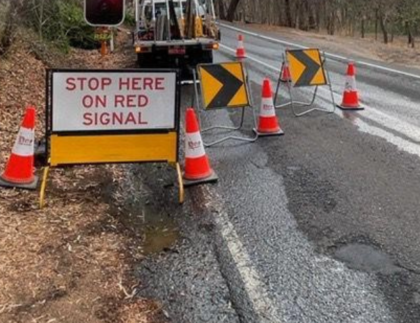
Single lane closure with traffic controller management is the most common arrangement for urban resurfacing works — one lane is closed to allow paving equipment to operate, and a single lane of alternating two-way traffic is managed through the work zone by controllers operating stop/slow bats at each end.
Rolling lane closure is used for large-scale highway resurfacing where the work progresses continuously along a road without stopping. The traffic management setup moves with the paving crew, maintaining a protected work zone around the equipment as it advances. This arrangement requires a well-coordinated team and experienced traffic management supervision, as the setup must be repositioned safely and without interruption to the paving operation.
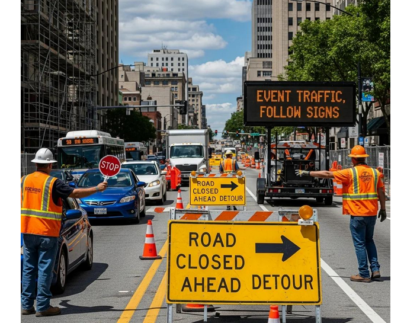
Full road closure with diversion may be required for resurfacing works on roads where a lane closure would leave insufficient width for safe vehicle passage, or where the volume and sensitivity of the work requires a fully protected environment. Full closures require advance public notification, coordination with council and DPTI, and clearly signed diversion routes that direct affected traffic through alternative road network paths.
The appropriate arrangement for any specific project depends on the road classification, the available road width, the traffic volume, the speed environment, and the specific equipment and staging requirements of the resurfacing operation. One of the most valuable contributions an experienced traffic management provider makes is recommending the right arrangement for the project — not just the simplest or cheapest option.
Night Works Traffic Management — Specific Requirements
As mentioned, many Adelaide resurfacing projects are scheduled for overnight operations to minimise daytime traffic disruption. Night works introduce a set of specific traffic management requirements that go beyond what a daytime operation requires.
Lighting. The work zone and the transition tapers on either side must be adequately illuminated so that both workers and approaching drivers can clearly see the traffic management setup. Arrow boards and portable lighting equipment are standard provisions for night resurfacing works.
Enhanced retroreflectivity. All signs and delineation devices must have appropriate retroreflective materials — which are more critical at night when ambient illumination is absent. Standard daytime signs may not provide adequate visibility for approaching drivers in nighttime conditions, and night works often require higher-grade retroreflective sheeting on key warning and regulatory signs.
Controller visibility. Traffic controllers working at night must wear Class D high-visibility garments — a higher standard than daytime requirements — and must be positioned to be clearly visible to approaching drivers. The use of additional lighting to illuminate controller positions is standard practice on night resurfacing operations.
Fatigue management. Night works introduce fatigue risks for both the paving crew and the traffic management team. Experienced traffic management companies in Adelaide managing night resurfacing projects will have fatigue management provisions in place — including crew rotation schedules and supervisor oversight — to ensure that the quality of traffic management does not deteriorate during extended overnight operations.
The Approval Process for Resurfacing Works
Asphalt and resurfacing projects on public roads require approval from the relevant authority before works commence — either DPTI for state-controlled roads or the relevant local council for council-managed roads. The approval process involves submitting a Traffic Management Plan and obtaining the necessary road works permits.
For resurfacing works that will be conducted at night or that will involve full road closures, additional notification requirements typically apply. These may include advance public notification through variable message signs positioned on the approach routes, formal notification to emergency services, coordination with public transport operators whose routes use the affected road, and direct communication with adjacent businesses and residents.
The timeline for TMP approval for resurfacing works is similar to other road works — typically two to four weeks for straightforward council submissions and four to six weeks for DPTI submissions on arterial roads. Projects with night works components or full road closure requirements may take longer to approve, reflecting the additional complexity and stakeholder coordination involved.
Starting the approval process early is particularly important for resurfacing projects because of their programme-sensitive nature — a delayed approval that pushes the works start date into a different seasonal window can have material consequences for asphalt laying conditions and project cost.
How Professional Traffic Management Protects Your Resurfacing Project
The traffic management arrangements around a resurfacing operation do more than keep workers and road users safe — they directly affect the commercial performance of the project. Poorly managed traffic that causes delays to the paving operation, interrupts the rolling programme, or results in a stop-work direction from a council or DPTI inspector has real, measurable cost consequences.
Professional road safety services from an experienced traffic management provider protect the resurfacing project in several specific ways:
- Pre-project TMP development that accurately reflects the staging and equipment requirements of the operation — so the approved arrangements support rather than constrain the paving crew’s programme.
- Experienced controller teams who understand the specific dynamics of resurfacing operations — how to coordinate with paving supervisors, when to hold traffic to allow equipment repositioning, and how to manage the transition from one stage to the next without disrupting the operation.
- Proactive compliance management — monitoring signage, delineation, and controller positions throughout the shift and adjusting as site conditions change, rather than waiting for a deficiency to be identified by an external inspector.
- Rapid response to changing conditions — weather changes, equipment breakdowns, programme revisions — that require the traffic management arrangements to be adjusted without compromising safety or compliance.
What to Look for When Choosing a Traffic Management Provider for Resurfacing Works
Not all traffic management providers have equal experience with asphalt and resurfacing operations. When selecting a provider for this type of work, it is worth asking specifically about their experience with resurfacing projects — including rolling lane closures, night works operations, and high-speed road environments.
The quality of a provider’s pre-project planning is also a strong indicator of their suitability. A provider who asks detailed questions about the project staging, equipment types, programme, and road classification before preparing a quote is demonstrating the kind of project-specific thinking that produces effective, compliant traffic management. One who quotes based on general assumptions without understanding the specifics of the operation is unlikely to produce a TMP that genuinely supports the project.
Strong road safety solutions for resurfacing works come from providers who treat traffic management as an integral part of the project rather than a compliance requirement to be satisfied at minimum cost. The difference between these two approaches is visible in the quality of the planning, the experience of the controller team, and the proactiveness of the on-site supervision throughout the operation.
Final Thoughts
Traffic management for asphalt and road resurfacing works in Adelaide is a specialist activity that requires more than a standard traffic controller setup. The moving nature of the operation, the size and speed of the equipment, the frequency of night works, and the often high-speed road environments where resurfacing occurs all demand careful planning, experienced personnel, and active on-site management throughout the project.
Principal contractors and project managers who engage experienced, specialist traffic management providers early in the planning process — and who treat traffic management as a project partner rather than a subcontracted formality — consistently achieve better safety outcomes, smoother programme delivery, and fewer compliance issues than those who leave this element of the project as an afterthought.
The roads being resurfaced are safer for everyone when the works are conducted safely. Getting the traffic management right is how that happens.