
Getting a lane closure wrong on an Australian road works site isn’t just a safety risk — it’s a direct compliance failure under AS 1742.3 and state Codes of Practice that can trigger stop-work orders, fines, and personal liability. At One Stop Traffic Solutions, every lane closure we manage is designed to the correct taper length, protected with industry-standard equipment, and documented for full regulatory compliance across NSW, VIC, and QLD.
What Is Lane Closure Traffic Control?
Lane closure traffic control is the planned, compliant process of closing one or more lanes of a road to create a safe work zone for civil works, utility maintenance, road resurfacing, or emergency repairs. Under Australian WHS legislation and AS 1742.3, every lane closure on a public road must be planned by an accredited traffic management professional and executed by certified traffic controllers.
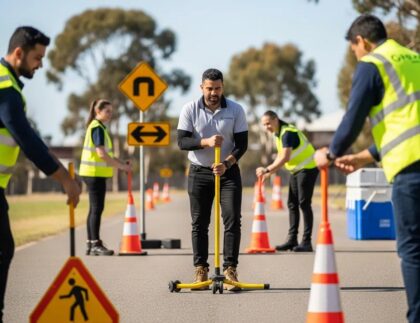
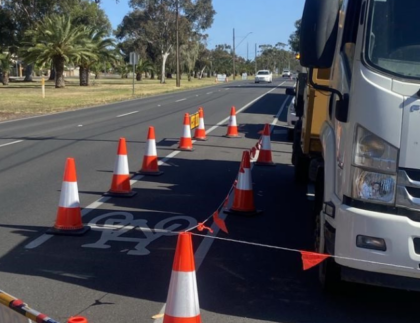
A lane closure is not simply placing cones on the road. It is a structured safety system that includes:
- Advance warning devices placed at legally required distances from the work zone.
- A mathematically calculated taper that merges traffic smoothly into the adjacent lane.
- A buffer zone between the taper end and the active work area.
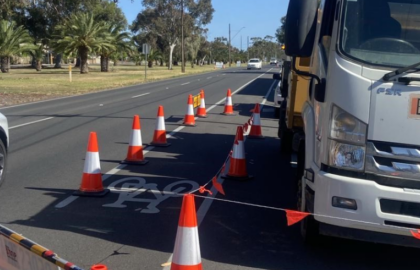
- Longitudinal channelling devices (bollards, cones) along the full closure length.
- An end taper to return traffic to the closed lane after the work zone.
- Certified traffic controllers or portable signals managing traffic flow.
| WHY THIS MATTERS: A taper that is too short causes panic merging and dramatically increases rear-end collision risk. A buffer zone that is too small puts workers in direct danger from errant vehicles. Both errors are compliance failures under AS 1742.3 — and both create personal liability for the site supervisor and principal contractor. |
AS 1742.3 Taper Length Requirements
Australian Standard AS 1742.3 (Manual of Uniform Traffic Control Devices — Part 3: Traffic Control Devices for Works on Roads) specifies minimum taper lengths based on posted speed limit and traffic volume. All taper lengths used by One Stop Traffic Solutions are calculated to meet or exceed these requirements.
| Posted speed limit | Min. merging taper (L) | Min. buffer zone | Min. end taper |
| 40 km/h | 20–30 m | 10–20 m | 10–20 m |
| 50 km/h | 40–55 m | 15–30 m | 15–25 m |
| 60 km/h | 55–75 m | 20–40 m | 20–35 m |
| 80 km/h | 80–120 m | 40–60 m | 30–50 m |
| 100 km/h | 120–175 m | 60–80 m | 50–70 m |
| 110 km/h | 145–200 m | 80–100 m | 60–80 m |
Source: AS 1742.3 — actual values vary based on lane width, road geometry, and state-specific Code of Practice. All One Stop Traffic Solutions designs are calculated site-specifically.
Equipment Used in Professional Lane Closure Traffic Control
The right equipment, correctly positioned, is as important as the correct design. One Stop Traffic Solutions deploys a full fleet of compliant, maintained equipment for every lane closure:
Variable Message Signs (VMS)
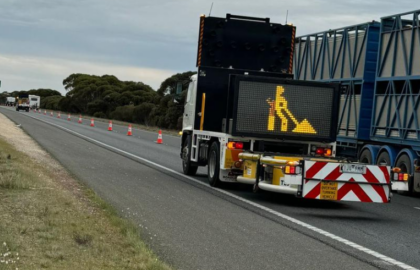
Solar-powered LED VMS boards are positioned at advance warning distances (typically 500m–2km before the closure on high-speed roads) to alert drivers well before they reach the work zone. VMS boards can display real-time updates, speed reductions, estimated delays, and detour instructions — significantly improving driver compliance and reducing late-braking events.
Truck-Mounted Attenuators (TMA)
On roads with a posted speed of 70 km/h or above, a TMA — also called an impact protection vehicle — is required under most state Codes of Practice. The TMA positions itself in the closed lane behind the work crew, absorbing the impact of an errant vehicle before it reaches workers. This is non-negotiable on arterial roads and motorways.
Bollards and Channelling Devices
High-quality retroreflective bollards meeting Australian Standard AS 1906.3 (retroreflectivity requirements) are used throughout the closure taper, buffer, and work area. Reflectivity performance must remain effective in all weather conditions and at night — we inspect and replace devices that fall below standard.
Portable Traffic Signals
For single-lane alternating situations (particularly on narrow roads, bridges, or through intersections), portable traffic signals provide more consistent traffic flow control than manual stop-slow bat operations — reducing controller fatigue and improving driver compliance over extended work windows.
Certified Traffic Controllers
All One Stop Traffic Solutions field personnel hold current state-issued Traffic Controller accreditation. Controllers are trained in AS 1742.3 device placement, emergency stop procedures, communication protocols, and driver de-escalation. Each controller carries a current copy of the Traffic Control Plan (TCP) for the site.
Lane Closure Traffic Control by State
While AS 1742.3 provides the national standard baseline, each Australian state applies additional requirements through its own Code of Practice (CoP). One Stop Traffic Solutions operates under all relevant state frameworks:
New South Wales
- Regulatory framework: Transport for NSW — Austroads Guide to Temporary Traffic Management (AGTTM) and NSW Code of Practice
- TMA requirement: Mandatory on roads with speed limit ≥70 km/h where workers are within the traffic environment
- Permit requirement: All lane closures on RMS/TfNSW roads require a Traffic Control Plan (TCP) prepared by a registered TMP author
- Night works: Additional lighting requirements under the NSW CoP for lane closures operating after sunset
Victoria
- Regulatory framework: VicRoads — Traffic Management for Works on Roads (TMFWOR) Code of Practice
- TMA requirement: Required on roads ≥80 km/h; recommended on roads ≥60 km/h near workers
- Accreditation: All Traffic Control Plans must be prepared by a VicRoads-accredited designer
- High-risk declarations: Some arterial lane closures in metropolitan Melbourne require a pre-commencement MATS (Method of Achieving Traffic Safety) review
Queensland
- Regulatory framework: Department of Transport and Main Roads (TMR) — MUTCD Queensland and TMR Traffic Control Manual
- TMA requirement: Mandatory on state-controlled roads with speed limits ≥80 km/h
- Blue Card: All traffic controllers must hold a current Queensland Traffic Controller Licence (Blue Card)
- Rural roads: Additional signing distances apply on undivided highways with high heavy-vehicle volumes
How Professional Lane Closure Management Improves Project Efficiency
A well-designed lane closure is not a hindrance to project speed — it is a productivity tool. Here is how professional traffic control accelerates civil works:
Maximising safe work windows
Our planners identify optimal work windows based on live traffic volume data for each road and time of day. By scheduling lane closures during low-volume periods, we minimise the risk of queue buildup that triggers road authority complaints or early closure withdrawals — giving crews longer, uninterrupted work shifts.
Right-sized resource deployment
Accurate site analysis means you deploy exactly the right number of traffic controllers for each shift configuration — no over-staffing, no compliance gaps. For multi-stage projects, our plans include a resource schedule aligned to each construction phase.
Preventing costly site shutdowns
A non-compliant lane closure setup — whether wrong taper length, missing advance signage, or inadequate TMA coverage — can be shut down immediately by a road authority inspector. Each shutdown costs project time, rebooking fees, and potential contractual penalties. Professional compliance planning eliminates this risk.
Frequently Asked Questions
Q: When is a Truck-Mounted Attenuator (TMA) required for a lane closure in Australia?
A: A TMA is required on roads with a posted speed limit of 70 km/h or above in most Australian states, where workers will be within the traffic environment. In NSW and Queensland this is a mandatory requirement under the relevant Code of Practice. In Victoria, TMAs are mandatory above 80 km/h and strongly recommended above 60 km/h. One Stop Traffic Solutions will advise on TMA requirements during your project scoping call.
Q: How is lane closure taper length calculated under AS 1742.3?
A: Taper length is calculated using the road’s posted speed limit, lane width, and — on higher-volume roads — traffic volume data. AS 1742.3 provides minimum taper length formulas, which our accredited designers apply site-specifically for every Traffic Control Plan. Minimum merging taper lengths range from approximately 20–30 m at 40 km/h to 145–200 m at 110 km/h.
Q: Do I need a permit for a lane closure in NSW, VIC, or QLD?
A: Yes. Any lane closure on a state-controlled road requires a Traffic Control Plan (TCP) prepared by an accredited designer and approved by the relevant road authority — TfNSW in NSW, VicRoads in Victoria, or TMR in Queensland. For local council roads, approval is required from the relevant council. One Stop Traffic Solutions manages all TCP preparation and permit submissions.
Q: How much does lane closure traffic control cost in Australia?
A: Lane closure traffic control costs depend on road classification, speed limit, duration, number of lanes closed, and whether TMA or VMS equipment is required. A short-duration local road closure costs significantly less than a multi-shift motorway lane closure with TMA protection. Contact One Stop Traffic Solutions for a transparent, itemised quote with no hidden fees.
Q: Can One Stop Traffic Solutions manage lane closures across multiple states?A: Yes. We provide AS 1742.3-compliant lane closure traffic control across NSW, VIC, and QLD, including all TCP design, road authority approvals, TMA deployment, certified controller staffing, and VMS hire. Our team is accredited under each state’s specific framework.