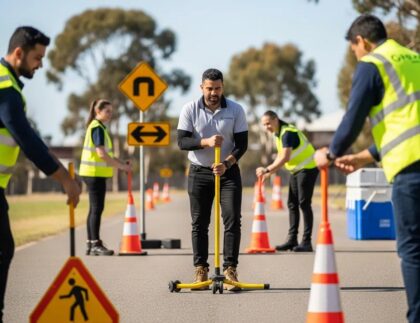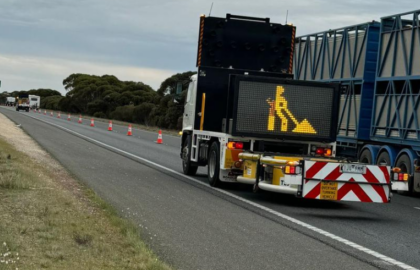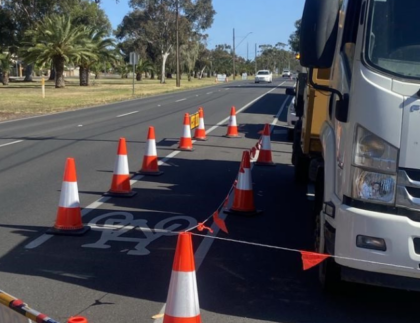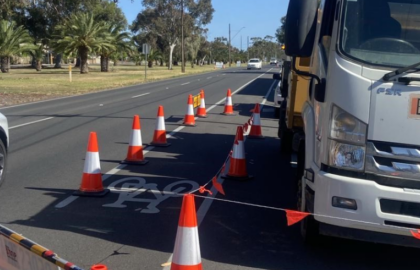


Whether you are organising a music festival, a major sporting event, a community market, or a road race in Australia, professional event traffic control is a legal requirement — not an optional add-on. Any event that affects a public road, footpath, or car park requires a council-approved Traffic Management Plan and certified traffic controllers on site. Getting it wrong means permit rejection, event cancellation, and personal liability under the Work Health and Safety Act 2011 if an incident occurs.
At One Stop Traffic Solutions, we manage end-to-end event traffic control across South Australia, New South Wales, Victoria, and Queensland — from Traffic Management Plan preparation and council approval through to certified controllers, pedestrian management, and full equipment deployment on event day.
Why Event Traffic Control Is Different from Construction Traffic Management
Event traffic management shares the same regulatory framework as construction traffic control — AS 1742.3, state Codes of Practice, and WHS legislation — but the operational demands are fundamentally different. The key distinctions:
Crowd surge and dispersal patterns: Unlike construction sites, events generate sharp traffic and pedestrian spikes at arrival and dispersal. A festival that takes four hours to fill will empty in 30–45 minutes. Traffic Management Plans for events must model both phases separately and provide specific controller positions, signal timing, and pedestrian routing for each.
Simultaneous vehicle and pedestrian management: Events bring high volumes of pedestrians into environments normally dominated by vehicles — car parks, arterial road crossings, venue access roads. Certified controllers must manage vehicle movements and pedestrian flows simultaneously, often in close proximity, requiring specific training and positioning that standard construction traffic setups do not cover.
Council and multi-agency coordination: Event permits require coordination with the local council, SA Police or state police, public transport authorities, and sometimes the state road authority simultaneously. Each agency has its own approval requirements and timelines. An event Traffic Management Plan that satisfies the council but not SA Police is still rejected.
One-chance execution: A construction project can adjust its traffic setup the next day if something is wrong. An event has a fixed date. A permit rejection two weeks before the event has no recovery — it cancels the event. Professional event traffic management means getting every approval right the first time.
Types of Events That Require Traffic Management in Australia
Any public event that affects a road, footpath, or public space accessible to vehicles requires council approval and a traffic management plan. This includes:
Music festivals and outdoor concerts — Large-scale events with 1,000+ attendees on dedicated festival sites or temporary venues require TMPs covering all vehicle access points, pedestrian crossing management, emergency vehicle corridors, and traffic control for surrounding road network impacts.
Sporting events — Road races, cycling events, fun runs, and triathlons that use public roads as the course require full road closure management with rolling closures, marshalling plans, and intersection control throughout the route.
Stadium and arena events — AFL, A-League, cricket, and major concert venue events require traffic management for the surrounding road network, not just the venue itself. Arterial roads, parking stations, and public transport interchange points all need planned management.
Community markets, festivals, and fairs — Council-managed public spaces and street events require traffic management plans even for smaller gatherings. Car park access, pedestrian crossing safety, and road closures for event setup and pack-down all require approval.
Corporate and commercial activations — Brand activations, product launches, and promotional events in public spaces or on private property with public access require councils to be satisfied that traffic and pedestrian impacts are managed.
Emergency and unplanned events — Protests, spontaneous public gatherings, and emergency diversions around unplanned incidents require immediate traffic management deployment. One Stop Traffic Solutions provides 24/7 emergency event traffic control response.
The Council Approval Process for Event Traffic Management in Australia
The event traffic management approval process differs from construction TMP approvals in one critical way: lead time is longer and less flexible. Council event approval calendars have fixed submission windows, and late submissions are not accommodated regardless of how compliant the plan is.
Step 1 — Determine all approving authorities Most events require approval from multiple bodies simultaneously: the local council (primary permit authority for the event), the state road authority if any state-controlled roads are affected, SA Police or state police for events above a threshold attendance, and public transport authorities if bus or tram routes are impacted.
Step 2 — Prepare the Event Traffic Management Plan The event TMP must include: pedestrian management diagrams for arrival and dispersal phases, vehicle access and egress plans for all entry points, emergency vehicle access corridors that remain clear throughout the event, parking management plan if off-site parking is used, controller position schedules for each event phase, and contingency plans for weather, early closure, or crowd overflow scenarios.
Step 3 — Submit with adequate lead time Submission lead times vary by council and event size:
- Small community events (under 500 people): Most councils require submission at least 4 weeks before the event
- Medium events (500–5,000 people): Typically 6–8 weeks minimum
- Large events (5,000+ people): Many councils require submission 3–6 months in advance, particularly for events requiring road closures or involving significant traffic impacts on the surrounding network
One Stop Traffic Solutions advises on the correct submission timeline for your specific event and council during the initial scoping consultation.
Step 4 — Respond to conditions and revisions Council approval for events often comes with conditions — specific controller positions, mandatory SA Police presence, noise curfews that affect pack-down traffic, or additional pedestrian barriers at specific locations. Our team manages all condition responses and plan revisions until final permit issue.
Step 5 — Brief controllers and mobilise All controllers receive an event-specific briefing covering the TMP, their individual position responsibilities, communication protocols, emergency procedures, and escalation contacts. For large events, a pre-event walkthrough of all controller positions is conducted to ensure real-world conditions match the plan.
Event Traffic Control by State
South Australia — Adelaide City Council, local councils, DIT, SA Police
Adelaide’s major event calendar — Fringe Festival, Adelaide 500, WOMADelaide, Clipsal, and the AFL season — makes SA one of the most event-dense traffic management environments in Australia. The Adelaide CBD’s tram network, narrow one-way streets, and high pedestrian volumes require event traffic management expertise specific to the city grid. One Stop Traffic Solutions has direct experience managing traffic for Adelaide CBD events and understands the Adelaide City Council’s specific permit requirements.
New South Wales — Local councils, TfNSW, NSW Police
NSW events on state-controlled roads require TfNSW involvement in addition to local council approval. For major events in Sydney, Parramatta, and regional NSW, Traffic Management Plans must meet both council and TfNSW requirements simultaneously. NSW Police involvement is mandatory for events above certain attendance thresholds.
Victoria — Local councils, VicRoads, Victoria Police
Victorian events affecting arterial roads require VicRoads approval alongside council permits. Metropolitan Melbourne events often impact public transport corridors managed by Public Transport Victoria (PTV), adding an additional coordination requirement. VicRoads-accredited TMP designers are required for any plan affecting arterial roads.
Queensland — Local councils, TMR, Queensland Police
Queensland’s outdoor event culture — from the Gold Coast to Cairns — generates consistent demand for event traffic management across urban and regional environments. TMR approval is required for events affecting state-controlled roads. All traffic controllers must hold a current Blue Card (Queensland Traffic Controller Licence).
Equipment Used in Professional Event Traffic Control
| Equipment | Purpose | Typical use at events |
|---|---|---|
| Variable Message Signs (VMS) | Parking availability, gate changes, traffic direction | Placed on approach roads 500m–2km from venue |
| Crowd control barriers | Pedestrian channelling, exclusion zones, queue management | Entry gates, crossing points, restricted areas |
| Portable traffic signals | Intersection control at high-pedestrian crossing points | Venue access roads, pedestrian crossing points |
| High-intensity lighting towers | Night visibility at crossing points, car parks, access roads | Evening and night-time events |
| Arrow boards | Traffic direction for parking access and egress | Car park entry/exit, road closures |
| Water-filled barriers | Vehicle exclusion zones around pedestrian areas | Concert venue perimeters, market areas |
| Certified Traffic Controllers | Live traffic and pedestrian direction | All vehicle/pedestrian interface points |
| Traffic Control Supervisors | On-site compliance management, controller coordination | Events with 4+ controllers |
What Professional Event Traffic Controllers Are Trained To Do
Event traffic controllers perform a different role to construction site controllers. In addition to standard AS 1742.3 traffic direction, event controllers are trained in:
Conflict de-escalation: Frustrated drivers, confused pedestrians, and impatient event attendees are a constant presence at large events. Controllers trained in de-escalation techniques resolve disputes quickly and calmly without escalating to SA Police or event security — protecting both safety and the event’s public reputation.
Emergency access management: Maintaining clear emergency vehicle corridors throughout an event — particularly during peak crowd periods when pedestrians spill into road space — requires specific crowd management techniques. All One Stop Traffic Solutions event controllers are briefed on emergency access routes before every event.
Dynamic traffic adjustment: Event traffic rarely follows the modelled scenario exactly. Controllers must be able to adjust signal timing, redirect queues, and alter pedestrian routing in real time based on actual crowd behaviour — without deviating from the approved TMP in ways that create compliance gaps.
Multi-agency communication: Event controllers are often the first point of contact for SA Police, event security, and venue management when an incident occurs. Clear radio communication protocols and defined escalation paths are briefed before every event.
How to Reduce the Risk of Event Permit Rejection
The most common reasons event Traffic Management Plans are rejected by councils and road authorities:
- Insufficient lead time — Submitted too close to the event date for the council’s standard approval timeline
- Missing pedestrian management diagrams — Dispersal phase not separately addressed from arrival phase
- Emergency vehicle access not documented — Corridors not shown on TCP diagrams or minimum width not specified
- SA Police or state police not consulted — Required for events above attendance thresholds
- No contingency plan — Council requires documented response to weather cancellation, early closure, or crowd overflow
One Stop Traffic Solutions designs all event TMPs to address each of these common rejection triggers before submission, achieving a high first-submission approval rate across all states.
Frequently Asked Questions
Q: Do I need a Traffic Management Plan for my event in Australia? A: Yes — any event that affects a public road, footpath, or publicly accessible car park in Australia requires a council-approved Traffic Management Plan and certified traffic controllers. This applies to events of all sizes, from community markets to major festivals. The specific requirements depend on your event size, location, and the road authority that controls the affected roads.
Q: How far in advance do I need to submit an event traffic management plan? A: Submission lead times vary by event size and council. Small events (under 500 people) typically require 4 weeks minimum. Medium events (500–5,000 people) require 6–8 weeks. Large events (5,000+ people) often require 3–6 months, particularly if road closures are involved. One Stop Traffic Solutions advises on the correct timeline for your specific event and council during the initial consultation.
Q: What is included in an event Traffic Management Plan? A: A compliant event TMP includes pedestrian management diagrams for arrival and dispersal phases, vehicle access and egress plans, emergency vehicle access corridors, parking management, controller position schedules for each event phase, and contingency plans for weather, early closure, or crowd overflow. It is submitted to the council, state road authority (if applicable), and police for approval.
Q: Do I need SA Police or state police approval for my event? A: Police involvement is mandatory for events above certain attendance thresholds — which vary by state and council. In South Australia, SA Police are typically consulted for events with 1,000+ attendees or those requiring road closures. In NSW and QLD, police requirements vary by local area command. One Stop Traffic Solutions manages all police consultation and approval as part of the event TMP process.
Q: How much does event traffic control cost in Australia? A: Event traffic control costs depend on event size, duration, number of access points, road classification, and controller staffing requirements. A small community market with two access points and minimal road impact typically costs significantly less than a major festival requiring arterial road closures and 10+ controllers across multiple shifts. Contact One Stop Traffic Solutions for a transparent, itemised quote based on your specific event.
Q: Can One Stop Traffic Solutions manage event traffic control across multiple states? A: Yes. We provide event traffic control services across South Australia, New South Wales, Victoria, and Queensland — managing TMP preparation, council and road authority submissions, police consultations, and certified controller staffing under each state’s specific framework.