
Construction sites in Australia present some of the most complex traffic management challenges in the civil industry. Workers, heavy machinery, delivery vehicles, and members of the public must coexist in the same compressed space — often metres from live traffic travelling at highway speeds. Under the Work Health and Safety Act 2011 (Cth) and Australian Standard AS 1742.3, every construction site that affects a public road requires a documented, approved traffic control system before works begin.
At One Stop Traffic Solutions, we provide end-to-end traffic control for construction sites across South Australia, New South Wales, Victoria, and Queensland — from Traffic Management Plan (TMP) creation and road authority approval through to certified controllers on the ground.
What Does Traffic Control for Construction Sites Actually Require?
Traffic control for construction is not simply placing cones around a work zone. Under AS 1742.3 and state Codes of Practice, a compliant construction traffic control system must include all of the following:
Approved Traffic Management Plan (TMP) A site-specific document submitted to the relevant road authority (Transport for NSW, VicRoads, TMR Queensland, or SA’s Department for Infrastructure and Transport) before works begin. The TMP outlines risk assessments, Traffic Guidance Scheme (TGS) diagrams, pedestrian management plans, and stakeholder notification requirements.
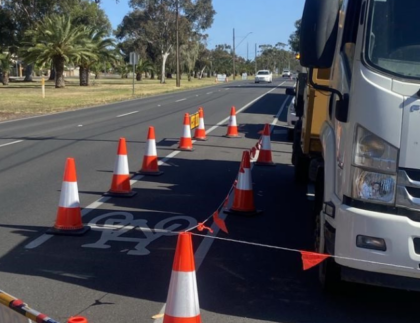
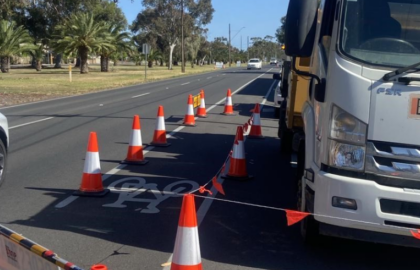
Traffic Control Plans (TCP Diagrams) Scale drawings showing the exact position of every sign, bollard, barrier, Variable Message Sign (VMS), and traffic controller for each phase of construction. All device placement must reference AS 1742.3 taper lengths and spacing calculations.
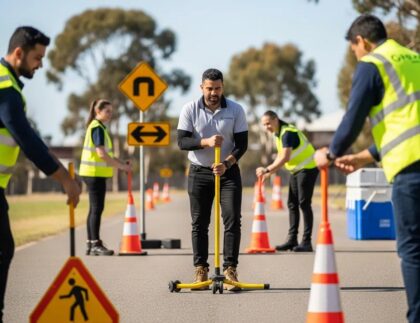
Certified Traffic Controllers All personnel directing traffic on a construction site must hold current state-issued Traffic Controller accreditation. Whether managing a high-rise build in the CBD or a suburban utility upgrade, professional construction site traffic control depends on controllers who carry a copy of the relevant TCP and are trained in AS 1742.3 emergency stop procedures.
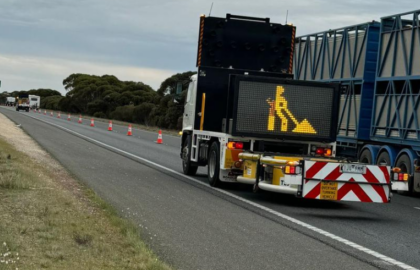
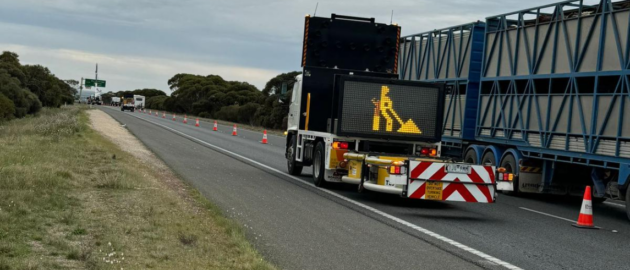
Physical Site Protection Depending on proximity to live traffic and posted speed limits, this includes retroreflective bollards (AS 1906.3 compliant), water-filled barriers, and — on roads with speed limits of 70 km/h or above — a Truck-Mounted Attenuator (TMA) positioned between workers and live traffic.
Permit and Road Occupancy Approvals Road occupancy permits are required from the local council or state road authority for any construction activity that reduces road capacity or closes a lane. One Stop Traffic Solutions manages all permit applications and revision responses on your behalf.
Managing Heavy Vehicle Access on Construction Sites
Concrete pours, steel deliveries, crane mobilisations, and excavation equipment movement require precise space and timing management. Poorly planned heavy vehicle access is one of the leading causes of construction traffic incidents in Australia.
Our Traffic Management Plans include:
- Swept path analysis — CAD modelling to confirm that all proposed access routes, turning circles, and delivery points can safely accommodate B-doubles, rigid trucks, concrete agitators, and emergency services vehicles
- Designated access points — Specific entry and exit zones to prevent site vehicles conflicting with public traffic flow at intersections
- Exclusion zones and spotting — Defined exclusion zones around reversing machinery, with trained spotters managing vehicle movements in restricted areas
- Delivery scheduling — Coordination with site managers to stagger heavy vehicle movements away from peak traffic periods, reducing road authority complaints and minimising queue buildup
Construction Traffic Control by State
Construction sites in different Australian states are governed by different regulatory bodies and Codes of Practice. One Stop Traffic Solutions is accredited and operational across all major states:
South Australia — Department for Infrastructure and Transport (DIT)
- Regulatory framework: AS 1742.3 + DIT Code of Practice for Traffic Management on Roads
- TMA requirement: Mandatory on roads with speed limits ≥70 km/h where workers are within the traffic environment
- Permit authority: DIT for state-controlled roads; local councils for residential and local streets
- Relevant to: Adelaide metropolitan construction, regional SA highway works, council road upgrades
New South Wales — Transport for NSW (TfNSW)
- Regulatory framework: Austroads Guide to Temporary Traffic Management (AGTTM) + NSW Code of Practice
- Approval timeframe: 10–15 business days for standard applications; longer for arterial road closures
- TMP authors must be registered with TfNSW
- Permit authority: TfNSW for state roads; local council for local streets
Victoria — VicRoads and Local Councils
- Regulatory framework: Traffic Management for Works on Roads (TMFWOR) Code of Practice
- TMP designers must hold VicRoads accreditation
- TMA mandatory on roads ≥80 km/h; recommended ≥60 km/h near workers
- Pre-lodgement meetings may be required for complex metropolitan projects
Queensland — Department of Transport and Main Roads (TMR)
- Regulatory framework: Manual of Uniform Traffic Control Devices (MUTCD) Queensland + TMR Traffic Control Manual
- All traffic controllers must hold a current Blue Card (Queensland Traffic Controller Licence)
- TMA mandatory on state-controlled roads with speed limits ≥80 km/h
- Additional signing distances apply on undivided rural highways
Essential Equipment for Construction Traffic Control
| Equipment | Purpose | When required |
|---|---|---|
| Variable Message Signs (VMS) | Advance warning of construction activity, speed reductions, and detours | All construction sites on roads ≥60 km/h; recommended all sites |
| Truck-Mounted Attenuator (TMA) | Physical barrier between workers and live traffic | Mandatory on roads ≥70–80 km/h (state-dependent) |
| Retroreflective bollards (AS 1906.3) | Lane delineation throughout taper and work zone | All construction sites |
| Water-filled barriers | High-impact separation between work zone and traffic | Longer-duration sites; high pedestrian areas |
| Portable traffic signals | Single-lane alternating control at intersections or narrow sections | Where manual stop-slow operation is insufficient |
| Lighting towers | Night-time visibility for workers and drivers | Early-start and late-night concrete pours; 24-hour works |
| Certified Traffic Controllers | On-ground direction of traffic and emergency response | Required whenever traffic is redirected or managed |
How Traffic Control Reduces Construction Project Costs
A common misconception is that professional traffic control adds cost to a construction project. In practice, it does the opposite when managed properly.
Preventing stop-work orders: A non-compliant traffic setup identified by a road authority inspector results in an immediate site shutdown. On large construction projects, a single unplanned stop-day can cost tens of thousands of dollars in idle labour, plant, and contractual penalties. A compliant TMP eliminates this risk.
Optimising work windows: Our planners identify the lowest-traffic periods for lane closures and access restrictions using live traffic volume data. Fewer traffic conflicts mean fewer complaints to the road authority, longer uninterrupted work shifts, and faster project completion.
Right-sized controller deployment: Accurate site phasing analysis means you deploy the correct number of traffic controllers for each construction stage — no over-staffing during low-activity phases, no compliance gaps during high-traffic periods.
Protecting the project reputation: Construction sites that cause significant community disruption attract council intervention, media attention, and client complaints. Professional traffic control minimises motorist frustration and protects the reputation of the civil contractor and the project owner.
Frequently Asked Questions
Q: Do I need a Traffic Management Plan for a construction site in Australia? A: Yes — any construction activity that affects a public road, footpath, or car park accessible to the public requires either a compliant Traffic Guidance Scheme (TGS) or a full Traffic Management Plan submitted to the relevant road authority. This applies in all Australian states and territories. Works that cannot be covered by a pre-approved TGS template require a full TMP.
Q: How long does traffic management approval take for a construction site? A: Standard TMP applications take 10–15 business days in NSW and QLD, and 10–20 business days in Victoria. South Australia timelines vary by project complexity. One Stop Traffic Solutions recommends submitting at least 4 weeks before planned works start to allow for road authority revision requests. We manage all correspondence on your behalf.
Q: What is the difference between a Traffic Management Plan (TMP) and a Traffic Control Plan (TCP)? A: A Traffic Management Plan is the overarching strategic document submitted to the road authority for approval. It covers risk assessments, pedestrian management, stakeholder notifications, and project-level planning. A Traffic Control Plan is a site-specific diagram showing the exact placement of signs, devices, and controllers for a particular work activity — it is an output of the TMP. Both are required for construction sites on public roads.
Q: When is a Truck-Mounted Attenuator (TMA) required on a construction site? A: A TMA is required when workers are within the traffic environment on roads with speed limits of 70 km/h or above in most Australian states. In NSW, the threshold is 70 km/h. In Victoria, 80 km/h mandatory and 60 km/h recommended. In QLD, 80 km/h on state-controlled roads. Your project’s applicable state Code of Practice governs the exact requirement — One Stop Traffic Solutions will advise during your scoping consultation.
Q: Can One Stop Traffic Solutions manage construction traffic control across multiple states? A: Yes. We operate across South Australia, New South Wales, Victoria, and Queensland. Our team holds state-specific accreditations for TMP preparation and manages road authority submissions, revision responses, and permit approvals in each state.
Q: How much does traffic control for a construction site cost? A: Costs depend on project size, duration, road classification, speed limit, number of access points, and equipment requirements. A straightforward residential street closure costs significantly less than a multi-stage arterial road construction project requiring swept path analysis, TMA deployment, and multi-authority approval. Contact us for a transparent, itemised quote.
Why One Stop Traffic Solutions for Your Construction Site
- Accredited TMP designers registered with TfNSW, VicRoads, TMR, and DIT
- Full fleet of compliant equipment — TMA, VMS, portable signals, lighting towers, barriers
- Certified traffic controllers available 24/7 including emergency response
- All TCP designs calculated to AS 1742.3 specifications — not estimated
- Complete permit management from first submission to final approval
- Transparent, itemised quotes with no hidden fees