
If you are managing a civil construction project, a utility upgrade, a road resurfacing program, or a public event in Australia, traffic control services are not optional — they are a legal requirement under the Work Health and Safety Act 2011 (Cth) and state road legislation. But not all traffic control providers offer the same scope of services, and choosing the wrong one can result in permit rejections, stop-work orders, and serious project delays.
This guide explains every component of professional traffic control services in Australia — what is legally required, what each service type covers, what equipment is involved, and what to look for when comparing providers.
What Are Traffic Control Services?
Traffic control services encompass the full range of planning, documentation, personnel, and equipment required to safely manage traffic around a worksite, event, or road closure on a public road in Australia. They are provided by accredited traffic management companies and must comply with Australian Standard AS 1742.3 and the relevant state Code of Practice.
At a minimum, compliant traffic control services in Australia include:
- A Traffic Management Plan (TMP) — prepared by an accredited designer and approved by the relevant road authority before works begin
- Traffic Control Plans (TCP diagrams) — scale drawings showing exact device placement for each work phase, referenced to AS 1742.3
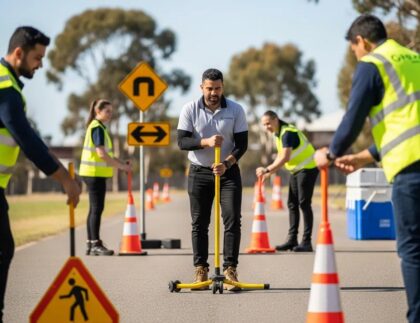
- Certified Traffic Controllers — holding current state-issued accreditation, present on site whenever traffic is being redirected
- Compliant equipment — signs, bollards, barriers, VMS boards, and where required, a Truck-Mounted Attenuator (TMA)
- Road occupancy permits — issued by the relevant road authority for each approved work period
Providers who offer only some of these components — for example, controllers without TMP preparation, or equipment without permit management — leave you exposed to compliance gaps that trigger enforcement action.
Types of Traffic Control Services Explained
1. Construction Site Traffic Control
Construction sites present the most complex traffic management requirements of any work category. Multiple access points, heavy vehicle deliveries, crane movements, concrete pours, and public pedestrian exposure must all be managed simultaneously, often over months or years.
A professional construction site traffic control service includes swept path analysis to confirm delivery vehicle access, phased Traffic Control Plans for each construction stage, exclusion zones and spotters for reversing machinery, and a TMA on all roads with speed limits of 70 km/h or above.
One Stop Traffic Solutions manages construction traffic control from TMP preparation and road authority approval through to daily controller deployment across SA, NSW, VIC, and QLD.
→ See full details: Construction Site Traffic Control
2. Lane Closure Traffic Control
A lane closure is one of the highest-risk operations in road works. Under AS 1742.3, every aspect of a lane closure — taper length, buffer zone, device spacing, and controller placement — must be mathematically calculated based on the posted speed limit and road geometry. There is no estimation.
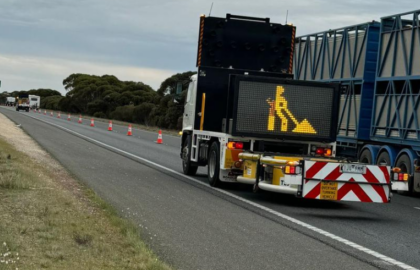
Minimum taper lengths under AS 1742.3 range from 20–30 metres at 40 km/h to 145–200 metres at 110 km/h. On roads with speed limits of 70 km/h or above, a Truck-Mounted Attenuator (TMA) is mandatory in most states to protect workers from errant vehicles.
A professional lane closure service covers TCP design to AS 1742.3 specifications, TMA deployment, Variable Message Sign (VMS) placement at correct advance warning distances, and certified controllers trained in emergency stop procedures.
→ See full details: Lane Closure Traffic Control
3. Traffic Management Plans and Road Authority Approvals
Many civil contractors and project managers engage a traffic control provider specifically for TMP preparation and permit management — the planning phase that must be completed before any physical traffic control can be deployed.
A compliant TMP includes a formal site risk assessment, Traffic Control Plans for every work phase, pedestrian and cyclist management provisions, swept path analysis, and a stakeholder notification plan. It is submitted to the relevant state road authority — Transport for NSW (TfNSW), VicRoads, TMR Queensland, or South Australia’s Department for Infrastructure and Transport (DIT) — for approval before works begin.
Approval timeframes typically run 10–15 business days in NSW and QLD, and 10–20 business days in Victoria and SA. Incomplete or non-compliant submissions are rejected, adding weeks to project start dates. One Stop Traffic Solutions manages all TMP preparation, submission, revision correspondence, and resubmission.
→ See full details: Traffic Management Plans and Approvals
4. Event Traffic Management
Public events — festivals, sporting events, concerts, markets, and commercial activations — that affect public roads require a different type of traffic management expertise to civil works. The focus shifts from worksite safety to crowd surge management, temporary public transport route changes, and simultaneous coordination with local councils, SA Police or state police, and event organisers.
Event Traffic Management Plans must account for arrival and dispersal peaks, spectator pedestrian flow across road corridors, accessibility requirements under the Disability Discrimination Act (DDA) 1992, and contingency protocols for early event closure or crowd overflow.
Key differences from construction traffic control include more complex pedestrian management requirements, the need for earlier permit submission due to council and road authority event approval calendars, and higher controller-to-pedestrian ratios at peak crowd movement periods.
5. Road Closure Management
Full road closures — where an entire section of road is closed to through traffic and a detour route is established — require the most comprehensive traffic management documentation of any service type. Requirements include detailed detour route analysis confirming the alternative route can handle the redirected traffic volume, swept path modelling for heavy vehicles on the detour, community and business notification plans, and coordination with emergency services for alternative access.
Full road closures on state-controlled roads typically require a longer approval period than lane closures and may require a pre-lodgement meeting with the road authority. One Stop Traffic Solutions manages the complete road closure permit process including detour route approval and all signage documentation.
6. Utility and Maintenance Traffic Control
Utility contractors — water, gas, telecommunications, and electrical — carry out some of the highest-frequency, shortest-duration traffic management activities in Australia. A single SA Water or APA Group maintenance program may require dozens of individual Traffic Guidance Scheme setups per month across metropolitan and regional areas.
Traffic control for utility works must balance speed of setup with full AS 1742.3 compliance. Where works can be covered by a pre-approved Traffic Guidance Scheme (TGS) template, no formal TMP submission is required — but the setup must still precisely match the approved layout. Where no TGS template applies — for example, on arterial roads or near intersections — a full TMP is required.
One Stop Traffic Solutions provides both TMP preparation and on-demand controller deployment for utility maintenance programs, including standing contracts for regular works programs.
→ See full details: Utility Traffic Management
Traffic Control Services by State
Australia has no single national traffic control authority. Each state applies AS 1742.3 through its own Code of Practice, with specific accreditation requirements, permit portals, and approval timeframes. One Stop Traffic Solutions is accredited and operational across four states:
| State | Road Authority | Key Standard | Approval Time | TMA Threshold |
|---|---|---|---|---|
| South Australia | DIT (arterials) / Local councils | SA Code of Practice + AS 1742.3 | 10–15 business days | ≥70 km/h |
| New South Wales | TfNSW (state) / Local councils | AGTTM + NSW Code of Practice | 10–15 business days | ≥70 km/h |
| Victoria | VicRoads (arterials) / Local councils | TMFWOR Code of Practice | 10–20 business days | ≥80 km/h mandatory; ≥60 km/h recommended |
| Queensland | TMR (state) / Local councils | MUTCD Queensland + TMR Manual | 10–15 business days | ≥80 km/h (state roads) |
Traffic Control Equipment: What a Professional Provider Should Deploy
The equipment deployed on your site directly determines whether your traffic control setup is AS 1742.3 compliant. Here is what each item does and when it is required:
Variable Message Signs (VMS) provide real-time advance warning to drivers approaching the work zone — showing speed reductions, lane closure information, and detour directions. Required on all roads with speed limits of 60 km/h or above; recommended on all sites. Solar-powered units are used for remote or extended projects.
Truck-Mounted Attenuators (TMA) are impact-absorbing vehicles positioned in the closed lane behind the work crew, designed to absorb an errant vehicle impact before it reaches workers. Mandatory in most states on roads with speed limits of 70–80 km/h or above. Non-negotiable on motorways and arterial roads.
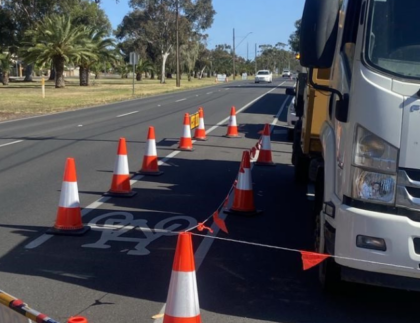
Retroreflective bollards (AS 1906.3) delineate the taper, buffer zone, and full length of the work area. Retroreflectivity must meet AS 1906.3 requirements — older or dirty bollards that fall below this standard are a compliance breach and must be replaced.
Portable traffic signals manage single-lane alternating traffic at intersections, narrow sections, or bridge works where manual stop-slow operation is insufficient. Reduce controller fatigue and improve driver compliance over long shifts.
Water-filled barriers provide high-impact separation between the work zone and live traffic for longer-duration sites, pedestrian-heavy areas, and CBD construction projects where bollards alone are insufficient.
Certified Traffic Controllers are the most important component of any traffic control service. They must hold current state-issued accreditation, carry the TCP on site, and be trained in AS 1742.3 emergency stop procedures. A site where controllers do not carry the current TCP is non-compliant — regardless of how well the signs are placed.
What Does Traffic Control Actually Cost in Australia?
Traffic control costs are determined by five factors: road classification, posted speed limit, project duration, number of work phases, and equipment requirements. Here is a practical cost framework:
Short-duration local road works (under 4 hours, ≤50 km/h): Typically the lowest cost tier. May be coverable by a pre-approved Traffic Guidance Scheme with a single certified controller and basic signage. No TMP submission required if a compliant TGS applies.
Multi-day construction site (arterial road, 60–80 km/h): Requires a full TMP submission, multi-phase TCPs, TMA deployment, VMS hire, and daily controller staffing. TMP preparation and approval is a separate cost from daily site operations.
Major road closure or multi-stage project: Highest cost tier. Involves TMP preparation with swept path analysis, multi-authority permit submissions, detour route signage, community notification plans, and sustained controller deployment across multiple shifts.
The cost of a compliant traffic control service is always significantly less than the cost of a stop-work order, a permit rejection causing project delay, or a workplace incident in an unsanctioned work zone. One Stop Traffic Solutions provides transparent, itemised quotes with no hidden fees — and our plans are designed for first-time approval to avoid revision delays.
How to Choose a Traffic Control Provider in Australia
Not all traffic management companies offer the same quality of service or scope of coverage. When evaluating providers, ask:
Are your TMP designers accredited in my state? TMP authors must be registered with the relevant road authority — TfNSW in NSW, VicRoads in Victoria, TMR in QLD, and DIT in SA. Unaccredited designers cannot submit TMPs for approval.
Do you manage the full permit process? Some providers deliver the TMP document but leave permit submission and revision management to the client. A full-service provider manages the entire submission process including all road authority correspondence.
What is your first-submission approval rate? A TMP rejected by the road authority sets your project back 10–20+ business days. Ask about revision history and how plans are quality-checked before submission.
Do you provide accredited controllers in my state? Controller accreditation is state-specific. A NSW-accredited controller cannot legally direct traffic in QLD without additional certification.
Can you scale for multi-site or 24-hour projects? Utility programs, large construction contracts, and emergency works often require simultaneous deployment across multiple sites. Confirm the provider has sufficient accredited personnel and equipment to staff your full program.
One Stop Traffic Solutions holds accreditation across SA, NSW, VIC, and QLD, maintains a full equipment fleet, and provides 24/7 emergency response capacity.
Frequently Asked Questions
Q: What traffic control services are legally required in Australia? A: Any activity affecting traffic flow on a public road requires at minimum a compliant Traffic Guidance Scheme (TGS) or a full Traffic Management Plan approved by the relevant road authority. Certified Traffic Controllers are required whenever traffic is being actively redirected. The specific requirements depend on the road classification, posted speed limit, and duration of works. One Stop Traffic Solutions will advise on the exact requirements for your project.
Q: What is the difference between a Traffic Management Plan and a Traffic Control Plan? A: A Traffic Management Plan (TMP) is the overarching strategic document submitted to the road authority for approval before works begin. It covers site risk assessments, stakeholder notifications, and the full project traffic strategy. A Traffic Control Plan (TCP) is a site-specific scale diagram showing the exact placement of every sign, device, and controller for a particular work activity — it is produced as part of the TMP and must be carried on site at all times.
Q: How far in advance do I need to book traffic control services? A: For projects requiring a full TMP submission, allow a minimum of 4 weeks before planned works start — 10–20 business days for road authority approval, plus preparation time. For projects coverable by a pre-approved Traffic Guidance Scheme, controller deployment can often be arranged with 48–72 hours notice. Emergency traffic control is available 24/7.
Q: Do traffic control services cost the same in every state? A: No. Costs vary based on state-specific accreditation requirements, permit fees, TMA requirements, and road classification. A project on an 80 km/h arterial road in Victoria has different compliance requirements — and therefore different costs — to the same physical works on a 50 km/h suburban street in SA. One Stop Traffic Solutions provides state-specific quotes for every project.
Q: Can One Stop Traffic Solutions manage traffic control across multiple states? A: Yes. We are accredited and operational in South Australia, New South Wales, Victoria, and Queensland. We manage TMP preparation, road authority submissions, permit approvals, and certified controller deployment under each state’s specific framework.