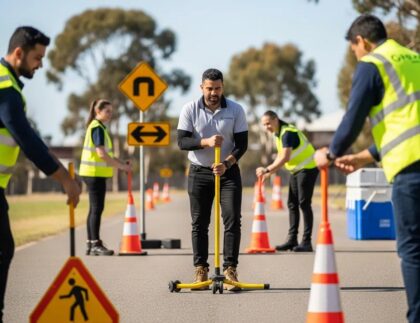

Whether you’re undertaking utility upgrades, civil works, or a major public event, securing a compliant Traffic Management Plan (TMP) is your first legal obligation — and your biggest risk factor if done incorrectly. At One Stop Traffic Solutions, we manage the entire TMP lifecycle: from detailed site analysis and documentation through to road authority approval in NSW, VIC, and QLD, backed by certified traffic controllers on the ground.
What Is a Traffic Management Plan (TMP)?
A Traffic Management Plan is a legally required, site-specific document that outlines how traffic, pedestrians, and cyclists will be safely managed during road works or events. It is submitted to the relevant state road authority for approval before any works can commence.
Under Australian Work Health & Safety (WHS) legislation and state-specific road rules, any activity that disrupts traffic flow on a public road requires a compliant TMP. Failing to obtain approval can result in:
- Stop-work orders from Transport for NSW, VicRoads, or TMR Queensland
- On-the-spot fines and prosecution under WHS/OHS legislation
- Personal liability for injuries or accidents occurring in the work zone
- Project delays and costly contract penalties
TMP vs. Traffic Control Plan (TCP) — What’s the Difference?
These two terms are often confused. Here’s a clear distinction:
| Traffic Management Plan (TMP) | Traffic Control Plan (TCP) | |
| What it is | Strategic planning & regulatory document | Site-specific diagram showing traffic device placement |
| Scope | Entire project lifecycle | Individual work activity or shift |
| Submitted to | State road authority (TfNSW, VicRoads, TMR QLD) | Kept on-site by the traffic controller |
| Regulatory basis | WHS Act + state road legislation | AS 1742.3 (Traffic Control Devices) + CoP |
TMP Approval Process: NSW, VIC & QLD
Australia has no single national approval body — each state has its own authority, timeframes, and documentation requirements. One Stop Traffic Solutions handles full submissions and revision management in all three major states.
New South Wales — Transport for NSW (TfNSW)
- Submission authority: Transport for NSW (TfNSW), formerly RMS
- Approval timeframe: Typically 10–15 business days for standard applications; allow more for complex road closures
- Key requirements: Site analysis, swept path analysis, pedestrian management plan, risk assessment.
- Portal: Submitted via the TfNSW Traffic Management portal with a registered TMP author
- Local roads: Submitted to the relevant local council, not TfNSW
Victoria — VicRoads & Local Councils
- Submission authority: VicRoads for arterial roads; local council for local streets
- Approval timeframe: 10–20 business days; complex projects may require a pre-lodgement meeting
- Key requirements: Compliance with VicRoads’ Traffic Management for Works on Roads (TMFWOR) code
- Accreditation: Plans must be prepared by a VicRoads-accredited Traffic Management designer
Queensland — Department of Transport and Main Roads (TMR)
- Submission authority: TMR for state-controlled roads; local council for local roads
- Approval timeframe: 10–15 business days standard; up to 4 weeks for significant projects
- Key requirements: Compliance with the Manual of Uniform Traffic Control Devices (MUTCD) Queensland
- Accreditation: Traffic controllers must hold a current Blue Card (Traffic Controller Licence)
| PRO TIP — Start Early Most project delays caused by traffic management are avoidable. Submit your TMP application at least 4 weeks before works commence to allow for revision requests from the road authority. One Stop Traffic Solutions manages all back-and-forth correspondence on your behalf. |
What’s Included in a Professional Traffic Management Plan?
Our TMP documentation is prepared to the highest standard and covers every element required for first-time approval:
- Site Analysis: Detailed Site Analysis
Review of speed zones, existing traffic volumes, intersection geometry, sight lines, and proximity to schools, hospitals, or high-pedestrian areas.
- Risk Assessment: Risk Assessment
Formal identification of all vehicle-to-vehicle and vehicle-to-pedestrian conflict points, consistent with Australian WHS/OHS requirements and the relevant state Code of Practice (CoP).
- Swept Path Analysis: Swept Path Analysis
CAD-based modelling to confirm that all proposed detour routes and access points can safely accommodate large commercial vehicles (B-doubles, rigid trucks, emergency services).
- Pedestrian & Cyclist Management: Pedestrian & Cyclist Management
Specific plans for maintaining accessible, continuous footpaths and cycle lanes in accordance with the Disability Discrimination Act (DDA) 1992.
- TCP Diagrams: Traffic Control Plans (TCP Diagrams)
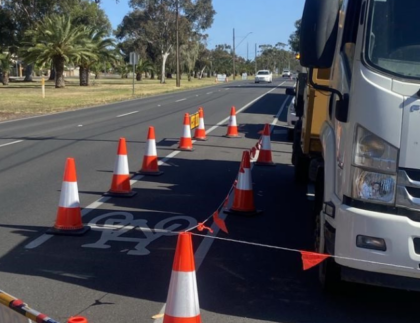
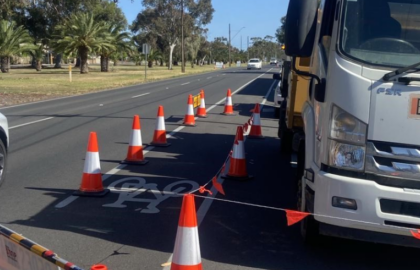
Detailed site diagrams showing device placement (signs, cones, barriers, VMS boards) for each stage of works, referenced to AS 1742 standards.
Traffic Management Equipment & Technology
Effective traffic management relies on more than personnel. One Stop Traffic Solutions deploys a full fleet of modern equipment:
Variable Message Signs (VMS) Hire
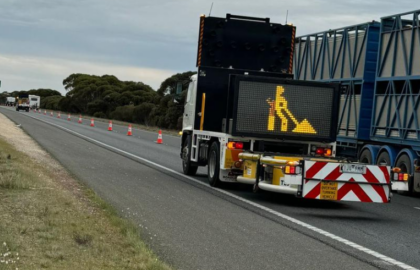
Portable LED VMS boards communicate real-time changes, delays, and detour instructions to drivers well before they reach the work zone. We provide solar-powered VMS units for remote or extended projects.
Impact Protection Vehicles (IPV)
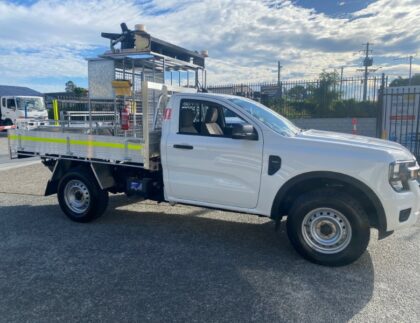
On high-speed roads (80 km/h+), an IPV positions itself as a physical barrier between workers and live traffic. This is required under the relevant state Code of Practice and is non-negotiable for safety.
Temporary Traffic Signals
For complex single-lane alternating situations or temporary intersection control, portable traffic signals outperform manual stop-slow bat operations — reducing controller fatigue and improving driver compliance.
Certified Traffic Controllers
All our field personnel hold current state-issued Traffic Controller accreditation and are trained in AS 1742.3 device placement, emergency protocols, and professional driver communication.
Frequently Asked Questions
Q: Do I need a Traffic Management Plan for my project?
A: Yes — any works or events that impact traffic flow on a public road in Australia require an approved TMP. This includes utility pit work, road resurfacing, building construction affecting footpaths, and public events with road closures. Even short-duration works (under 1 hour) require at minimum a Traffic Guidance Scheme (TGS).
Q: How long does TMP approval take in NSW?
A: Standard applications submitted to Transport for NSW typically take 10–15 business days. Complex applications involving major road closures, freeway works, or special conditions may take longer. We recommend submitting at least 4 weeks before your planned start date.
Q: How much does a Traffic Management Plan cost in Australia?
A: TMP costs vary depending on project size, duration, and complexity. A straightforward local road application typically costs less than a major arterial road closure requiring swept path analysis and multi-stage TCPs. Contact One Stop Traffic Solutions for a transparent, itemised quote.
Q: What is the difference between a TMP and a Traffic Guidance Scheme (TGS)?
A: A Traffic Guidance Scheme (TGS) is a simplified, pre-approved layout from the relevant Code of Practice, used for low-risk, short-duration works. A full Traffic Management Plan is required where no suitable TGS template exists — for example, complex intersections, high-speed roads, or works near schools.
Q: Can One Stop Traffic Solutions handle approvals in multiple states?
A: Yes. We manage TMP submissions and approvals across NSW (TfNSW), Victoria (VicRoads), and Queensland (TMR), as well as local council submissions. Our team is familiar with each state’s specific documentation requirements and revision processes.
Q: What happens if I start works without an approved TMP?A: Working without an approved TMP can result in immediate stop-work orders, fines issued under state road legislation, and personal liability under WHS/OHS law if an incident occurs. In NSW, penalties can exceed $10,000 per offence for individuals and significantly more for corporations.