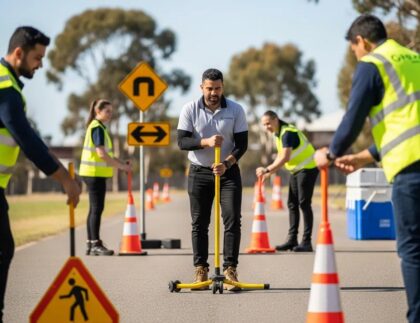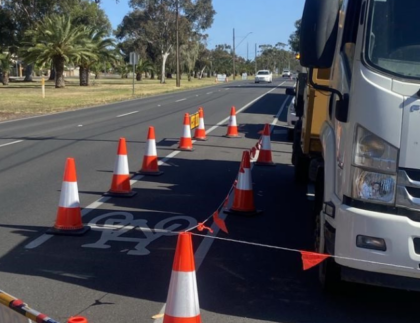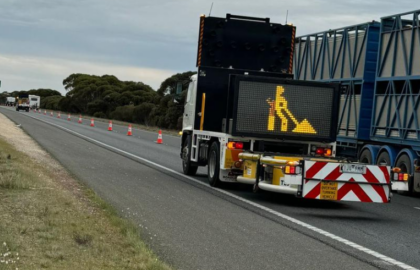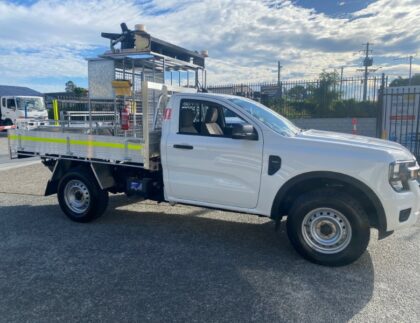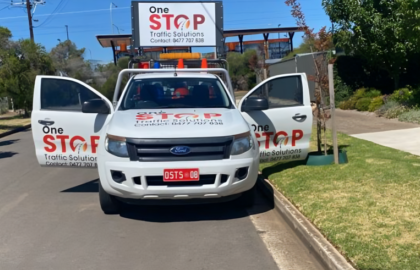

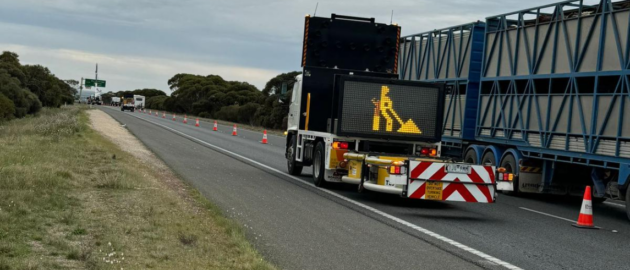
In Australian civil infrastructure, there is zero room for guesswork. Every sign, every cone, and every traffic controller must be positioned with precision — protecting your workforce, the public, and your project timeline.
This is where Traffic Control Plans (TCP) — also known as Traffic Guidance Schemes (TGS) — become the most critical document in any project manager’s arsenal.
At One Stop Traffic Solutions, we specialise in converting complex safety requirements into clear, compliant, and actionable traffic control plans that meet the rigorous AS 1742.3 Australian Standards — every single time.
What Is a Traffic Control Plan (TCP)?
A Traffic Control Plan is a detailed, site-specific technical diagram that maps out exactly how traffic — vehicles, cyclists, and pedestrians — will be safely managed around a worksite.
Unlike a Traffic Management Plan (TMP), which provides the broad strategic overview of a project, a TCP provides the precise on-the-ground instructions your team needs.
A professionally designed TCP includes:
- Advance Warning Area — Exact placement of “Roadwork Ahead” signs and speed reduction notices
- Transition Area — Calculated taper lengths based on road speed and lane width
- Activity Area — Safe zones for machinery, personnel, and necessary buffer spaces
- Termination Area — Clear instructions for traffic to return to normal conditions
A poorly designed TCP isn’t just a paperwork problem — it’s a direct safety risk and a legal liability.
Why Traffic Control Plans Are Legally Required in Australia
Operating without a certified TCP on an Australian worksite is a major legal offence. Regulatory bodies including VicRoads, local councils, and state road authorities require compliant TCPs before any work can begin.
The consequences of skipping or cutting corners on your TCP include:
- Immediate site shutdowns
- Significant financial penalties
- Project timeline delays
- Increased public liability exposure
- Permit rejections and resubmissions
Our team at One Stop Traffic Solutions understands the nuances of local and state legislation across South Australia and beyond. We design every plan to be “approval-ready” — accounting for street lighting, bus stops, pedestrian crossings, driveway access, school zones, and council-specific requirements so your permits are granted without unnecessary back-and-forth.
A Professional TCP Is an Investment, Not Just a Compliance Box
Many contractors view traffic control plans as a hurdle. In reality, a high-quality TCP is a direct driver of project efficiency and cost savings.
Here’s how a professionally engineered TCP works in your favour:
1. Reduces Congestion & Public Complaints
Optimised lane configurations keep traffic flowing smoothly, minimising bottlenecks and reducing the likelihood of community complaints that can stall your project.
2. Boosts Worker Confidence & Productivity
When your crew knows they are working within a well-designed, compliant safety system, productivity increases and incident rates drop.
3. Protects You During Audits & Incidents
Comprehensive, documented traffic control plans provide the paper trail that protects your business if an audit occurs or an on-site incident is investigated.
4. Speeds Up Permit Approvals
A compliant, well-structured TCP submitted to councils or VicRoads gets approved faster — keeping your project on schedule from day one.
Technology & On-Site Expertise Combined
At One Stop Traffic Solutions, we don’t rely solely on digital tools. We combine the latest CAD-based traffic planning technology with real-world, on-site field experience.
Our planners physically visit worksites to identify obstructions, hazards, and real-world conditions that satellite imagery or desktop planning simply cannot capture — especially on complex inner-city bypasses, school zones, or high-volume arterial roads.
Every TCP we produce is:
- Fully compliant with AS 1742.3 Australian Standards
- Tailored to your specific site conditions
- Designed to meet council and authority requirements
- Reviewed by qualified traffic management professionals
- Deliverable fast — so your project doesn’t wait
Who Needs a Traffic Control Plan?
If your project involves any of the following, a certified TCP is mandatory:
- Road and footpath maintenance
- Civil construction and utility works
- Council infrastructure upgrades
- Events on or near public roads
- Emergency roadworks and incident management
- Telecommunications and NBN rollouts
- Landscaping and tree removal near traffic
Whether you’re managing a single-lane road closure or a multi-stage urban infrastructure project, One Stop Traffic Solutions has the experience and resources to deliver.
Common TCP Mistakes That Cost Projects Time & Money
Even experienced contractors can fall into these traps:
| Common Mistake | Consequence |
|---|---|
| Using a generic TCP template | Permit rejection, non-compliance |
| Ignoring pedestrian management | Safety incidents, fines |
| Incorrect taper lengths | Audit failures |
| Not updating TCP for site changes | Legal liability |
| Missing council-specific requirements | Delays and resubmissions |
A site-specific, professionally designed TCP eliminates every one of these risks.
Secure Your Site with One Stop Traffic Solutions
The success of your roadwork or civil project starts with the quality of your traffic control plan. Don’t leave your site safety — or your project timeline — to a generic template.
One Stop Traffic Solutions delivers site-specific, AS 1742.3 compliant traffic control plans across Adelaide and South Australia — fast, accurate, and approval-ready.