
South Australia’s infrastructure pipeline has never been busier. From the North-South Corridor project and Metrolink upgrades to suburban utility renewals and council road resurfacing programs, the demand for compliant, reliable traffic control in Adelaide is growing every year. Whether you are a civil contractor, project manager, or council works coordinator, getting traffic management wrong in SA means exposure to Department for Infrastructure and Transport (DIT) enforcement, stop-work orders, and personal liability under the Work Health and Safety Act 2011.
At One Stop Traffic Solutions, we provide fully DIT-compliant traffic control across the Greater Adelaide region — from the CBD and inner suburbs through to regional SA highways. Our team manages everything from Traffic Management Plan (TMP) creation and DIT permit approval to certified controllers on the ground and full equipment deployment.
Why DIT Compliance Is Non-Negotiable for Adelaide Traffic Control
All traffic control activity on South Australian roads is governed by the Department for Infrastructure and Transport (DIT) and must comply with the SA Standards for Traffic Control Devices and Australian Standard AS 1742.3 (Manual of Uniform Traffic Control Devices — Part 3: Traffic Control for Works on Roads).
Any activity that disrupts normal traffic flow on a public road in SA — including construction sites, utility works, event road closures, and emergency repairs — requires:
- A documented Traffic Management Plan (TMP) approved by DIT or the relevant local council before works begin
- Traffic Control Plans (TCP diagrams) showing exact placement of all signs, devices, and controllers for each work phase, referenced to AS 1742.3 specifications
- Certified Traffic Controllers holding current SA accreditation, carrying the TCP on site at all times
- Road occupancy permits from DIT or the relevant local council for any activity that reduces road capacity
- Compliance with SA’s Code of Practice for Traffic Management, which specifies taper lengths, buffer zone distances, and equipment requirements based on posted speed limit
Failure to comply can result in immediate site shutdown by a DIT inspector, fines under the Road Traffic Act 1961 (SA), and personal liability for the principal contractor under WHS legislation if an incident occurs.
Adelaide-Specific Traffic Control Challenges We Solve
Adelaide’s road network presents traffic management conditions that national traffic control providers often underestimate. Our local knowledge directly improves your project outcomes:
North-South Corridor and Major Arterial Roads
The North-South Corridor project — SA’s largest infrastructure investment — creates cascading traffic impacts across the inner south and north of Adelaide. Works on the Southern Expressway, Torrens Road, and connector arterials require traffic control setups that account for high-speed through traffic, heavy freight movements, and residential access — simultaneously. Our team has direct experience managing traffic on SA’s arterial network and understands DIT’s specific requirements for these high-risk environments.
Adelaide CBD Construction Sites
The CBD presents a unique combination of narrow streets, high pedestrian volumes, tram and bus priority corridors, and 24-hour delivery requirements. Construction sites on King William Street, Rundle Mall precinct, Grenfell Street, and surrounding blocks require Traffic Management Plans that coordinate with the Adelaide City Council, DIT, and the Department of Planning, Infrastructure and Natural Resources (DPIR) simultaneously. Our planners know which permits go to which authority and how to avoid the revision cycles that delay CBD project starts.
Inner Suburbs and Council Roads
Traffic control on local roads in suburbs including Prospect, Norwood, Unley, Thebarton, Glenelg, and Salisbury is governed by individual councils, not DIT. Each council has its own application portal, approval timeframes, and local traffic conditions. Contractors who submit a DIT-formatted TMP to a council — or vice versa — face automatic rejection. One Stop Traffic Solutions manages council-specific submissions across all Adelaide metropolitan councils.
Fringe Festival, Adelaide 500, and Major Events
Temporary road closures for major Adelaide events require a different type of traffic management expertise — one focused on pedestrian crowd management, temporary bus and tram route changes, and coordinating with SA Police, Adelaide City Council, and event organisers simultaneously. Our event traffic management plans account for the surge-and-dispersal crowd movements that make standard traffic control setups ineffective at events.
DIT Permit and Approval Process in South Australia
Understanding the SA approval process is essential to avoiding the delays that cost civil contractors time and money. Here is how the DIT traffic management approval process works in practice:
Step 1 — Determine the road authority State-controlled roads (most arterial roads, expressways, and highways) fall under DIT. Local streets and car parks fall under the relevant local council. Some projects span both — requiring parallel submissions.
Step 2 — Prepare the Traffic Management Plan The TMP must be prepared by an accredited traffic management designer. It includes the site risk assessment, Traffic Control Plans for each work phase, pedestrian and cyclist management details, swept path analysis where required, and stakeholder notification plan.
Step 3 — Submit for approval DIT applications are submitted through the DIT online portal. Standard approval timeframes are 10–15 business days for straightforward applications. Complex projects — particularly those affecting arterial roads, intersections, or involving lane closures on 80+ km/h roads — may take longer and often involve revision requests. One Stop Traffic Solutions manages all submission correspondence and revisions.
Step 4 — Obtain road occupancy permit Once the TMP is approved, a separate road occupancy permit is required for each distinct work period. Permits specify the approved hours, lane configuration, and conditions. Works outside approved hours are a compliance breach.
Step 5 — Mobilise and execute Our certified controllers arrive with a copy of the current TCP, the required equipment, and communication systems. Any unexpected site condition that requires deviation from the approved TCP must be escalated to the TMP author — not improvised on site.
Traffic Control Equipment We Deploy in Adelaide
| Equipment | Purpose | When required |
|---|---|---|
| Variable Message Signs (VMS) | Advance warning, speed reductions, detour info | All works on roads ≥60 km/h; recommended all sites |
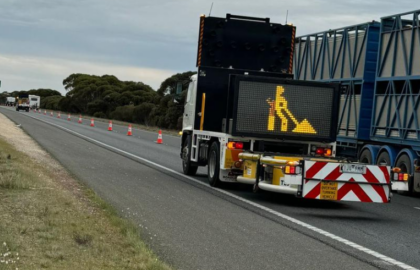
| Truck-Mounted Attenuator (TMA) | Worker protection from errant vehicles | Mandatory on SA roads ≥70 km/h with workers in traffic environment |
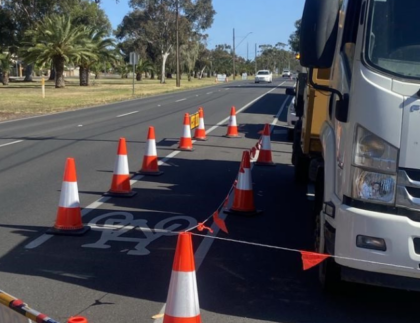
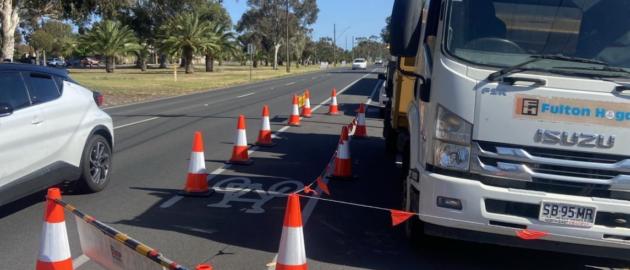
| Retroreflective bollards (AS 1906.3) | Taper and work zone delineation | All traffic control sites |
| Water-filled barriers | High-impact separation, longer-duration sites | CBD works, pedestrian-heavy areas, multi-week closures |
| Portable traffic signals | Single-lane alternating at intersections or narrow roads | Where stop-slow operation is insufficient |
| Arrow boards | Lane guidance and merge direction at tapers | High-speed arterials; night-time works |
| Lighting towers | Night visibility for workers and road users | Early-morning concrete pours, after-dark works, 24-hr sites |
| Certified Traffic Controllers | On-ground traffic direction and emergency response | All sites where traffic is redirected or managed |
Services We Provide for Adelaide Traffic Control
Construction site traffic control — Full TMP and TCP design, DIT and council permit management, certified controller staffing, TMA and VMS deployment for building and civil construction sites across Adelaide.
Road works and utility traffic control — Traffic management for SA Water, ElectraNet, and private utility contractors carrying out pit access, pipe laying, and cable works across the Adelaide metropolitan area.
Event traffic management — Temporary road closures, pedestrian crowd management, and event traffic plans for Adelaide CBD events, sporting events, community festivals, and commercial activations.
Emergency traffic control — 24/7 emergency response for unplanned road incidents, infrastructure failures, and urgent utility repairs requiring immediate traffic management deployment.
Council road works — Traffic management plan preparation and on-ground control for local council road resurfacing, kerb and gutter works, drainage, and footpath programs across all Adelaide metropolitan councils.
Frequently Asked Questions
Q: What permits do I need for traffic control in Adelaide? A: Permits in SA depend on which road authority controls the road. For state-controlled roads (arterials, expressways, highways), you need a Traffic Management Plan approved by DIT plus a road occupancy permit for each work period. For local streets, you need equivalent approval from the relevant local council. One Stop Traffic Solutions determines the correct authority and manages all permit applications on your behalf.
Q: How long does DIT traffic management approval take in SA? A: Standard DIT applications take 10–15 business days for straightforward projects. Applications involving arterial road closures, intersections, or works on 80+ km/h roads often take longer due to additional review requirements and revision requests. We recommend allowing at least 4 weeks from TMP submission to planned works start.
Q: Do I need a Truck-Mounted Attenuator (TMA) for my Adelaide project? A: In South Australia, a TMA is mandatory when workers are within the traffic environment on roads with a posted speed limit of 70 km/h or above. This covers most Adelaide arterial roads, the Southern Expressway, and all state highways. On lower-speed local roads, TMA use is assessed on a risk basis. One Stop Traffic Solutions will advise during your project scoping consultation.
Q: Can you manage traffic control for both a DIT road and a council road on the same project? A: Yes. Many Adelaide projects cross the boundary between state-controlled and council-controlled roads — particularly in inner suburbs where arterial roads adjoin local streets. We manage parallel submissions to both DIT and the relevant council, coordinate approval timelines, and ensure your Traffic Management Plan meets the requirements of both authorities.
Q: What is the difference between a Traffic Management Plan and a Traffic Control Plan? A: A Traffic Management Plan (TMP) is the overarching strategic document submitted to DIT or your local council for approval. It covers risk assessments, site analysis, stakeholder notifications, and the full project traffic strategy. A Traffic Control Plan (TCP) is a scale diagram showing the exact placement of signs, devices, and controller positions for a specific work activity — it is an output of the TMP and must be carried on site by all traffic controllers.
Q: Do you provide traffic control for events in Adelaide? A: Yes. We manage event traffic control across the Adelaide CBD, inner suburbs, and regional SA — including temporary road closures, pedestrian crowd management, and coordination with Adelaide City Council, SA Police, and event organisers. Event TMPs have different requirements to construction TMPs and require earlier submission due to council and road authority event calendars.